

Home » Learn about Woodland Stewardship » Working with a Chainsaw in Your Woods » Buying and Maintaining a Chainsaw
Buying and Maintaining a Chainsaw
Buying and Maintaining a Chainsaw
This page is intended as a safety refresher for landowners, not a replacement for formal training. Make sure you have proper chainsaw safety training, and consider professional help for projects beyond your knowledge. Please also consider your own personal health before starting strenuous activities like using a chainsaw. Talk to your physician to understand potential health risks from chainsaw use.
Related webpages
Chainsaws are a powerful and effective tool to complete woodland management tasks such as bucking up firewood, removing invasive plants, maintaining trails, and more. But not all saws are the same for every task, so how do you decide which one to buy? And once you’ve got a saw, how do you keep it performing as well as it did when it was new? This guide covers how to decide which saw to purchase and how to properly maintain your saw. Diligent maintenance is the key to a reliable and long-lasting chainsaw.
Electric vs gas-powered chainsaws
When buying a chainsaw, the first thing to decide is whether you want a gas-powered saw or an electric saw. Simply put, gas chainsaws operate via liquid fuel, and electric chainsaws operate via battery or an electrical cord.
As technology continues advancing, electric saws are becoming more available, popular, and powerful. Compared to gas saws, electric ones offer a faster start, weigh less, create less noise (though we still recommend hearing protection), and require less maintenance.
Some options are corded, meaning you will have to plug them into the wall and use an extension cable. That allows you to use your saw as long as you want without running out of power, but it limits your range of projects. On the other hand, battery-operated saws allow you to go as far into the woods as you need. However, they are limited by their battery life, so you may want to have a backup battery ready on hand. Compared to corded saws, battery-powered saws have a lower power output, so they are not as effective with larger cuttings—though that might change with future technology.
Gas-powered chainsaws offer maximum power and can take on projects from small cuttings to large-diameter wood or professional use. They can run for longer periods of time than battery-powered saws—just refuel in the field if you need more time. Two downsides are that gas-powered chainsaws are much louder than electric, and gas saws require more in-depth maintenance around carburetors, spark plugs, and fuel mixing. It takes more effort to start a gas chainsaw as well. However, many professionals like that effort—it helps their body and mind to remember they are handling a dangerous machine! The good news is that these are all things that you can learn to do, and there are many professionals in person and online available to help.
Kevlar chaps and electric saws
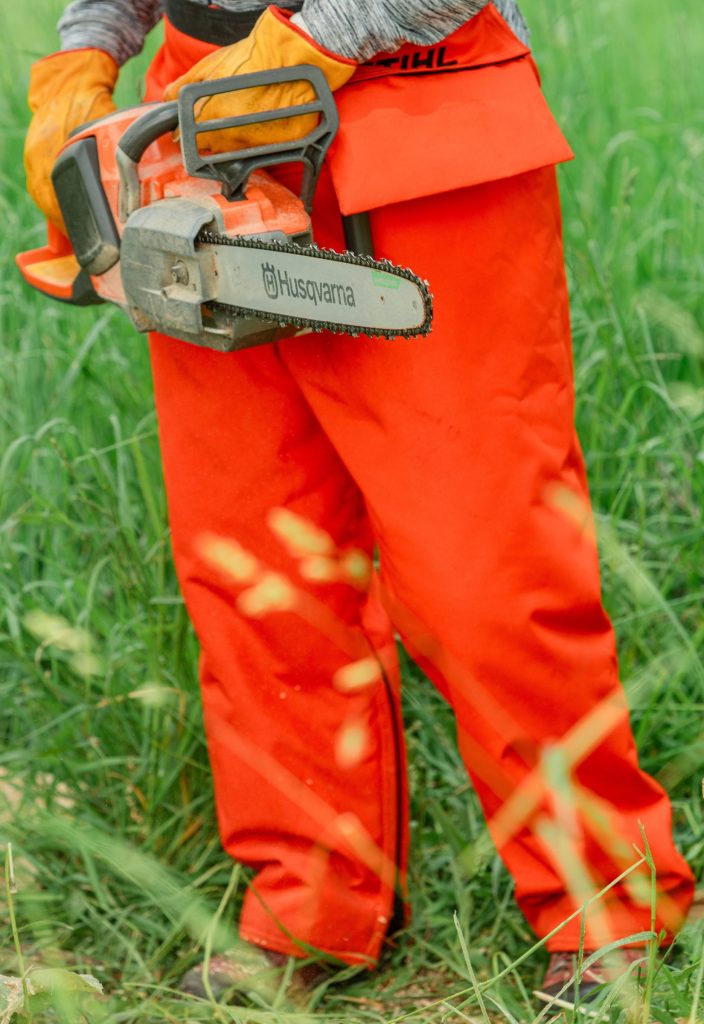
Kevlar chaps (a key piece of protective gear) interact differently with electric versus gas chainsaws. Kevlar is a strong synthetic fiber designed to stop a running saw chain by jamming it with fibers.
If a running gas chainsaw comes in contact with chaps, the outer shell may be cut, but the Kevlar fibers will be pulled lose and into the drive sprocket, which immediately stops the chain and prevents it from cutting further. If your chaps are uncompromised, well cared for, and fitting properly, this method protects your legs very well while using a gas-powered saw.
With electric saws, chaps still offer some protection but may be less effective than with gas saws due to the constant high torque of electric motors. An electric saw won’t always stop when it hits Kevlar fibers, meaning electric saws can continue to cut through the chaps. That said, please always wear chaps even when using electric saws—chaps still offer important protection!
Chainsaw size
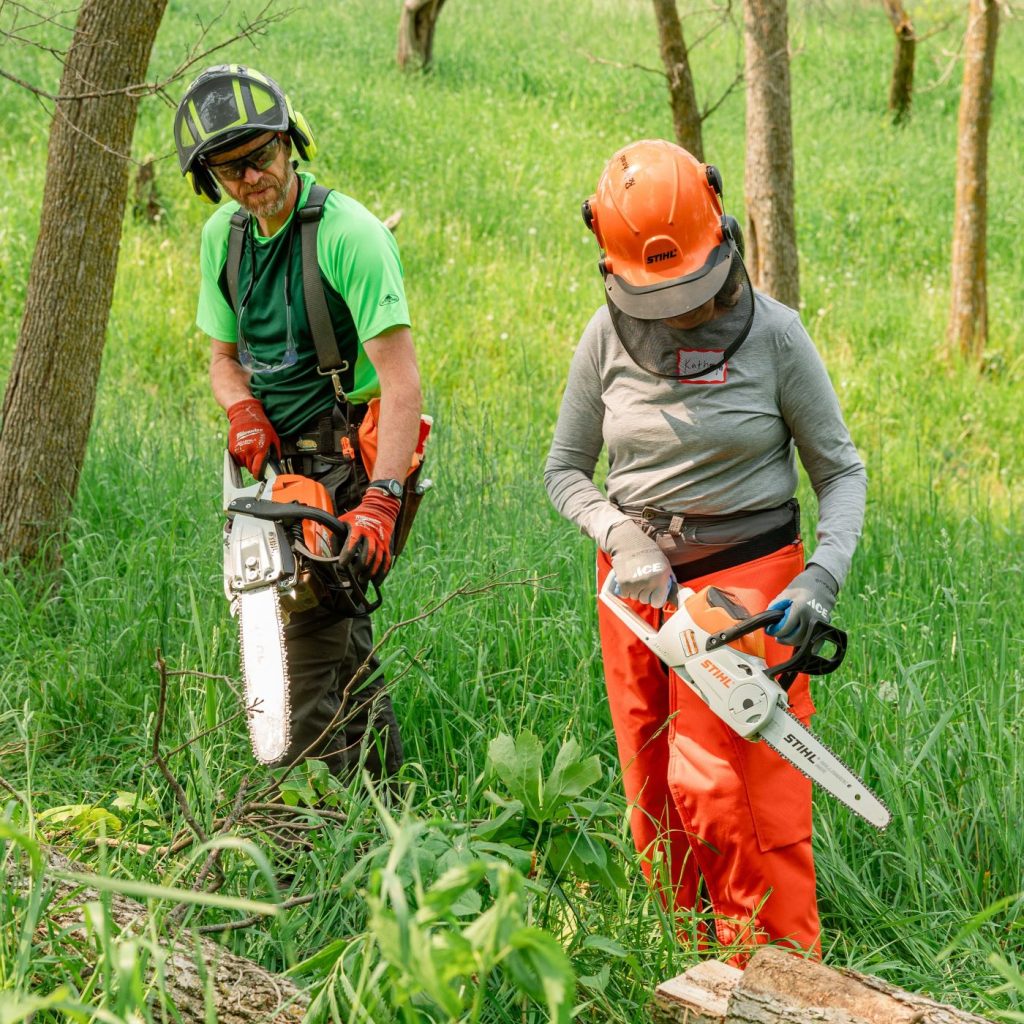
Along with power, you might ask which size of chainsaw you should use. Chainsaw sizes are determined by the bar length: small, medium, or large.
- Small bars, often called “homeowner saws,” are about 6 to 10 inches. They are often used for pruning, trimming, and occasional use. They can be lightweight and have a quick-start design to help folks with shoulder mobility issues.
- Medium bars, referred to as “farm & ranch saws,” often range from 10 to 18 inches. They are reliable for routine woodland maintenance, storm debris, and most firewood.
- Lastly, “professional” or large saws are 18 or more inches in length. They are used for heavy-duty work such as large tree felling or logging.
Think about the projects you will most likely be doing and what you can take on. If you inherited an older saw from a neighbor or family friend, it can usually get your job done, but always check the safety features and the condition of the saw. It might be best to assume the fuel is old and test the chain brake immediately to ensure this critical safety feature is functioning. Also make sure to go through our safety checklist before you take your heirloom into the woods!
Fueling and oiling
It’s not just old saws that need to be assessed and examined. Routine maintenance helps keep your chainsaw around longer and ensures it performs the way you wish.
If you have a gas saw, you’ll need to keep its fuel and oil in good shape. Often, you can mix this yourself or buy a pre-mix from most hardware stores. To mix your own fuel you will need a one-gallon gas container, synthetic 2-cycle engine oil, and gas. Fill gas to the one-gallon gas line, then add 2.6 fl oz of oil per gallon of gas. (We suggest double-checking the user’s manual to see the manufacturer’s recommended gas-to-oil ratio for your specific saw.) This mixture expires after 1 to 2 months, so we recommend running the saw until empty if you know you won’t use it for a long time (like over the winter).
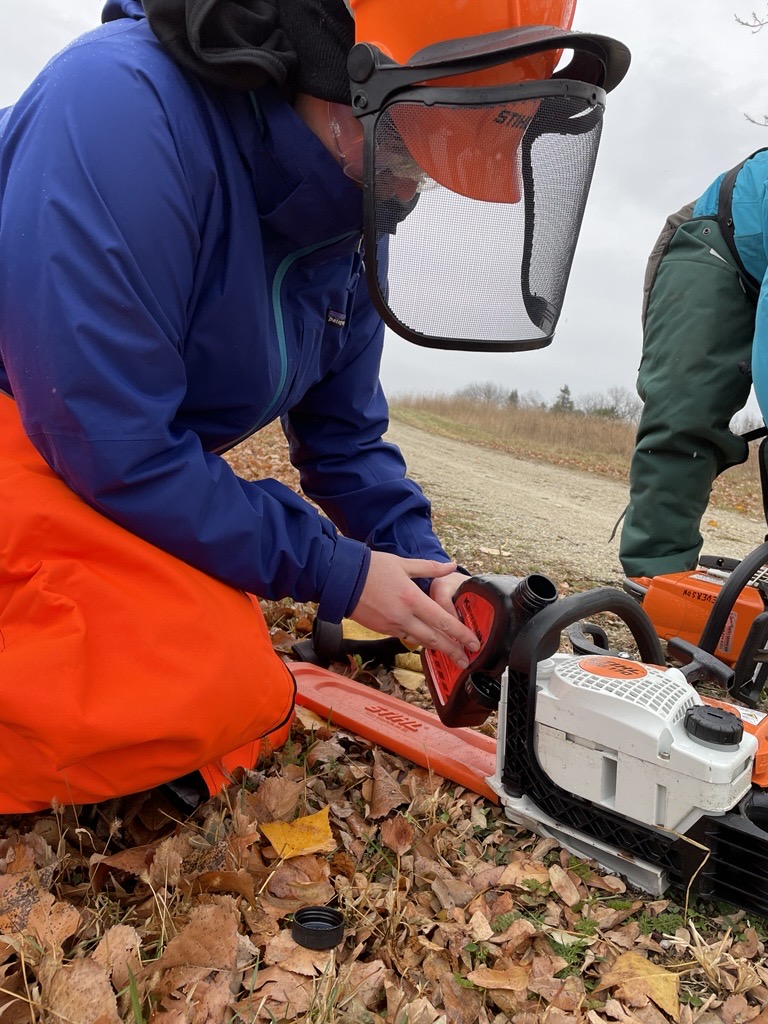
While it may seem obvious, it’s worth emphasizing because chainsaws are often used near burning brush piles: do not refuel within 20 feet of active flames.
Another aspect of routine maintenance is using dedicated bar and chain oil. Don’t use a generic oil like WD-40—you will want specific bar oil that is made to adhere to the chain and reduce friction. If your saw is cutting slower or getting bogged down, that’s a sign that you may need to add oil. The chain will be creating friction on the wood or the bar without lubrication, which can cause your chain and bar to wear down faster and impact your cutting ability. Additional signs you may need to add oil include excessive smoke or overheating, odd grinding sounds, or the chain getting jammed—all caused by friction causing the chain to stick.
Before adding bar oil, make sure the chainsaw is turned off and completely cooled—working on a hot saw can lead to burned fingers. Start by brushing away or using compressed air to blow away and debris or sawdust so no particles end up in the oil reservoir. Then find the oil tank near the handle (it’s marked with a small oil drop icon). Inside, you will see MIN and MAX lines; try to keep the oil level well filled and between these marks. Running a saw with too little or too much oil can cause damage over time and affect how well your saw cuts. To know whether the oiler is working, test the engine without cutting anything—you want to see a small mist of oil coming from the tip of your bar.
Lastly, a simple habit to keep your saw in good shape is to refill your bar oil every time you add gas to your saw.
Sharpening the chain
Chainsaws operate using a series of cutter teeth mounted on a rotating chain. Each cutter removes small chips of wood to create a cut. As the chain moves through the wood, the top plate of the cutter lifts the chip off the bottom of the cut while the side plate separates the chip from the wall of the cut. The depth gauge controls how deep the cutter tooth enters the wood, which determines the thickness of the chip removed.
A sharp chain will create wood shavings. A dull chain creates dust and makes the sawyer want to push hard, which is an unsafe habit that can lead to fatigue and increases the risk of kickback. You should sharpen your saw when you experience any of the follow:
- Chain doesn’t “pull” itself into the cut
- Smoke is produced in the cut
- The cut “wanders”
- The saw “chatters” or makes a rattling sound (the bar is skipping across the wood rather than cutting through it)
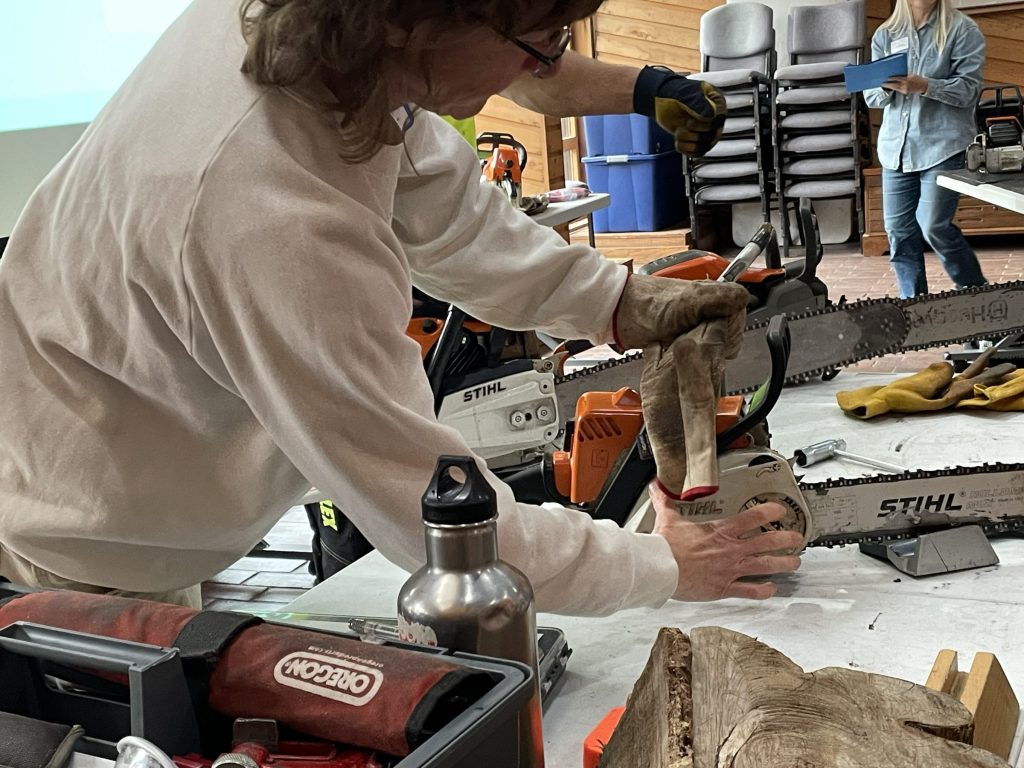
Before sharpening, make sure to turn your chainsaw off (and if it’s battery-powered, remove the battery from the saw). Then begin by tightening the chain tension slightly. To adjust chain tension, you will need to loosen the bar nuts and turn the tensioning screw until the chain sits snugly against the bar but can still be pulled around by your hand. This helps stabilize the cutter teeth and keeps proper filing angles. Each cutter tooth has a code indicating the chain pitch, which corresponds to a specific round file size (your sharpening tool). You can find the chain pitch often printed on the chainsaw bar (common examples include 3/8″, .325″, or 1/4″), and each pitch corresponds to a specific round file size for sharpening.
When filing, hold the file at a consistent 90-degree angle to the cutter and only apply pressure on the forward stroke, lifting the file on the return stroke to avoid dulling it. A helpful technique is to mark one cutter tooth with a Sharpie where you plan to file. After three strokes, check how much of the marker has been removed to gauge your progress and ensure you’re filing evenly. Once you’ve finished sharpening, return the chain to its normal tension (slightly loosening the tensioning screw and re-tightening the bar nuts) before re-inserting the battery and running the saw again.
Parts of the cutter
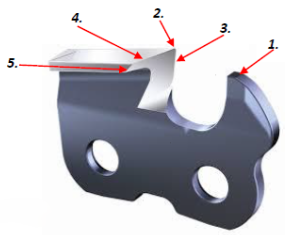
- Depth gauge: sets the thickness of the fiber that is cut
- Point: breaks into and begins to cut the fiber
- Side plate: cuts fiber off (side of the kerf) (15 degrees, +/- 10 degrees)
- Top plate: lifts fiber up in the kerf (usually 25 or 30 degrees)
- Chisel: angle under the top plate (45 degrees or larger)
To cut smoothly, all teeth on the chain must have:
- A sharp cutting point
- Consistent angles on the top plate, side plate, and chisel
- Consistent height difference between point and depth gauge (usually 0.025 degrees)
For a visual tutorial on how to sharpen a chainsaw, watch this video from Iowa State Extension.
Cleaning and troubleshooting
Regular cleaning is essential to keep your chainsaw running safely and efficiently. After each use, allow the saw to cool down, then check for and remove debris, sawdust, and oil buildup from around the chain, bar, and sprocket cover. Use a rag, a soft brush, or compressed air to clean fine particles. When particles get in small nooks on chainsaws, it can affect key functions and safety features, so pay close attention to the bar groove, oil holes, and areas around the clutch and chain brake.
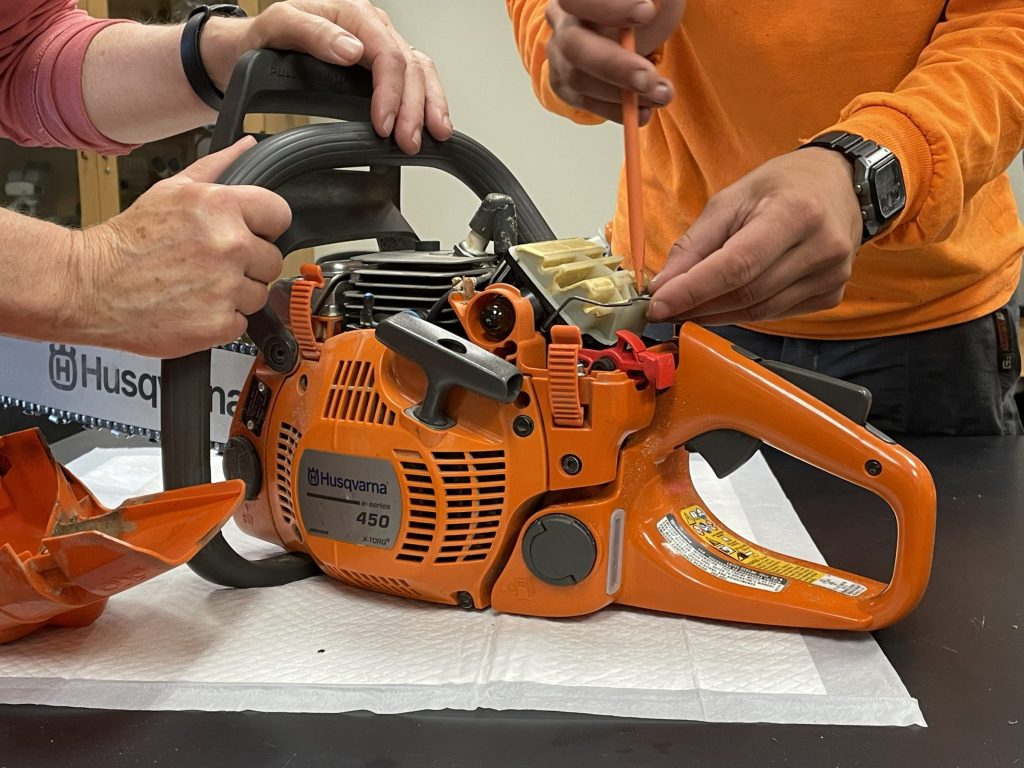
If your chainsaw isn’t running properly, a few simple troubleshooting checks can save time and frustration. Check for yourself:
- Is the spark plug in good condition?
- Is the fuel fresh?
- Is there any fuel in the tank?
- Is the air filter clean?
These are basic fixes you can learn to do yourself, or you can take your saw to a local small-engine mechanic. If you are interested in learning more about chainsaw troubleshooting and maintenance, check out these video from Iowa State Extension.
Additional resources
Explore all learning hub webpages
Woodland stewardship topics
Use a chainsaw safely & effectively
> Protective gear for safe chainsaw use
> Grow mushrooms using sawdust spawn
> Grow mushrooms using plug spawn
People and programs who provide assistance
If you have feedback on this webpage, fill out this form. If you have questions about working with a chainsaw, contact:

Olivia Kovacs
Natural Resources Educator
olivia.kovacs@wisc.edu
608-509-3012
Page written by Olivia Kovacs and Sky Hershberger (UW–Madison Extension). Last updated July 2026.